
WELCOME BONUS 300%
UP TO €2000 + 100
FREE SPINS
UP TO €2000 + 100
FREE SPINS
Home → Roulette
Roulette at Jackbit Casino
European Wheel with 37 Pockets Explained
The European Roulette wheel features 37 pockets, comprising numbers 1 through 36 and a single zero (0). This configuration results in a house edge of 2.70%. All bets on this wheel, from straight bets to even-money wagers, are subject to this consistent statistical advantage for the casino.
Within the European Roulette framework, a straight bet on a single number pays 35:1. This payout ratio is consistent across all single number bets, regardless of whether it's an inside bet or part of a larger group. The RTP for European Roulette stands at 97.30%.
The consistent payout structure on the European wheel means that the house edge of 2.70% applies uniformly. For example, even-money bets like Red/Black or Odd/Even offer a 1:1 payout, but the presence of the single zero pocket ensures the casino retains its advantage over time.
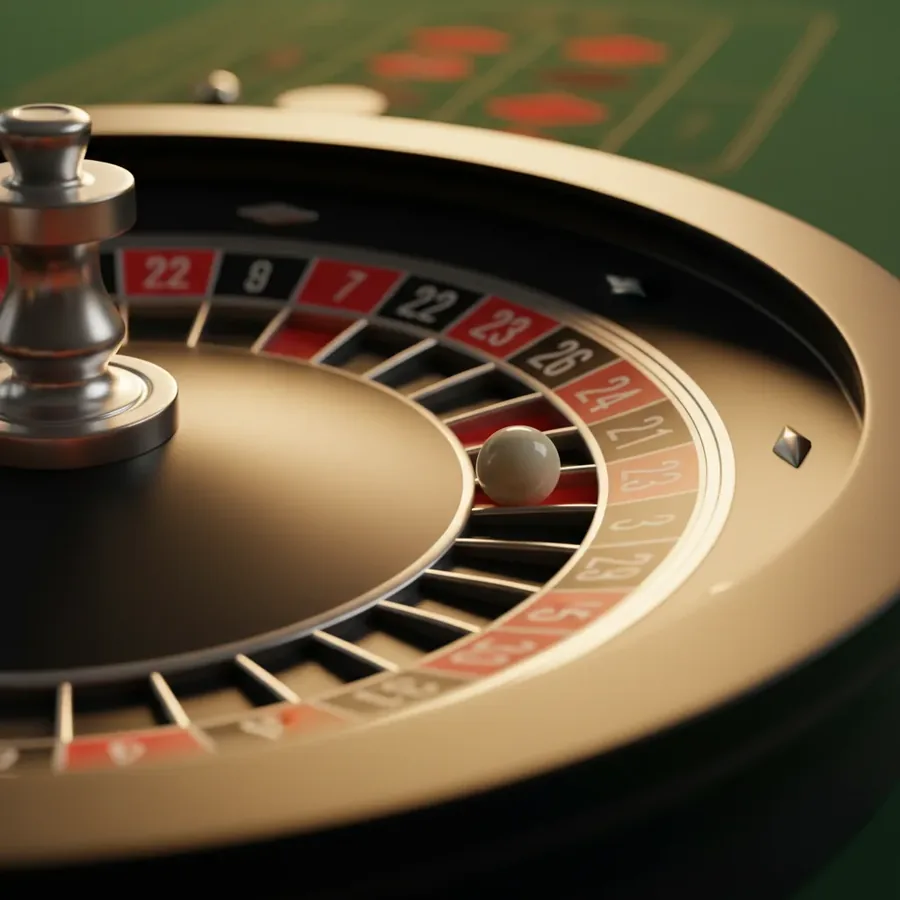
36 Instead of 37: The Math Behind 35:1
The payout of 35:1 for a straight bet in European Roulette is derived from the 37 available pockets on the wheel. Mathematically, if there were only 36 pockets and no zero, a 36:1 payout would eliminate the house edge. The single zero pocket, however, creates the statistical imbalance.
This 35:1 payout is calculated assuming players only bet on the 36 numbered pockets, excluding the zero. For every 37 units wagered on a single number, the expectation is to win 35 units plus the original bet back, resulting in a net win of 35 units. However, the 37th possibility (the zero) makes this expectation unfavorable.
The house edge of 2.70% on European Roulette directly stems from this 35:1 payout on 37 possible outcomes. This means for every €100 bet on a single number, the casino expects to retain €2.70 over the long run, illustrating the mathematical advantage inherent in the game's design.
Session Limit 25 Euro and Fixed Number of Rounds
The platform imposes a session limit of €25 for table games, including roulette. This means a player's total wager within a single gaming session cannot exceed this amount. This limit is applied regardless of the specific roulette variant played. The contribution of table games to bonus wagering is 10%.
This fixed round structure, combined with the €25 session limit, suggests a focus on controlled and potentially shorter gaming periods for players engaging with roulette.
For players utilizing the 300% welcome bonus up to €2,000, the €25 session limit on roulette tables is a critical factor. It means that the wagering requirement calculation for bonus funds will be significantly constrained by the maximum allowable bet per session on these games.
How Much Bonus Wager for 100 Euro Roulette Bet?
The welcome bonus offers 300% up to €2,000 plus 100 free spins. If a player claims the full €2,000 bonus, and the wagering requirement is, for example, 40 times the bonus amount, the total wagering needed would be €80,000. However, due to the 10% contribution from roulette, this translates to €800,000 in actual roulette wagers.
How the Random Generator Maps 37 Pockets
The random number generator (RNG) at the heart of online roulette simulations is programmed to replicate the physical probabilities of a real wheel. For European Roulette, the RNG must generate outcomes that correspond to the 37 distinct pockets with statistical accuracy.
Each spin of the virtual wheel is an independent event, meaning the RNG assigns a number from 0 to 36 with equal probability for each spin. The RTP of 97.30% for European Roulette indicates that, over a vast number of simulated spins, the generator is designed to return this percentage of wagers back to players.
The house edge of 2.70% is a direct consequence of the RNG's output distribution. While each number has an equal chance of being selected on any given spin, the fixed payout of 35:1 for a straight bet ensures the casino's long-term profitability.
Roulette bet types at a glance
| Bet | Payout | Win Chance | Numbers Covered | House Edge |
|---|---|---|---|---|
| Roulette Amerikanisch – Five Number Bet (0, 00, 1, 2, 3) | Five Number 6:1 (deckt 5 von 38 Sektoren) | 92.11% | Einzige Wette am amerikanischen Rad mit Edge über 5,26% – „Fallenwette“. Kein Äquivalent am europäischen Rad | 7.89% |
| Roulette Amerikanisch (doppelte Null, 38 Sektoren) | Straight 35:1, Split 17:1, Street 11:1, Corner 8:1, Six Line 5:1, Dozen 2:1, Column 2:1, Rot/Schwarz 1:1 | 94.74% | 38 Sektoren (1–36 + 0 + 00); Auszahlungen wie beim europäischen Rad, aber der zusätzliche Sektor verdoppelt den Hausvorteil | 5.26% |
| Roulette Französisch mit La Partage (gerade Chancen) | Rot/Schwarz 1:1 (bei 0 Rückerstattung 50%), Odd/Even 1:1, Low/High 1:1; Innere Einsätze ohne La Partage: Straight 35:1, Split 17:1, Street 11:1, Corner 8:1 | 98.65% | Bei 0 wird die Hälfte des Einsatzes auf gerade Chancen zurückerstattet (Rot/Schwarz, Pair/Impair, Manque/Passe). En Prison gibt denselben 1,35%. Regel gilt NUR für gleiche Einsätze | 1.35% |
| Roulette Französisch, innere Einsätze (La Partage gilt nicht) | Straight 35:1, Split 17:1, Street 11:1, Corner 8:1, Six Line 5:1, Dozen 2:1, Column 2:1 | 97.30% | Rad gleich (37 Sektoren), aber La Partage/En Prison gilt nicht für innere Einsätze – Edge bleibt europäisch | 2.70% |
| Roulette Europäisch (einfache Null, 37 Sektoren) | Straight 35:1, Split 17:1, Street 11:1, Corner 8:1, Six Line 5:1, Dozen 2:1, Column 2:1, Rot/Schwarz 1:1, Odd/Even 1:1, 1-18/19-36 1:1 | 97.30% | 37 Sektoren (1–36 + 0); Auszahlungen wie für 36 Sektoren – daher konstanter Edge auf ALLE Wetten | 2.70% |
Why the Ball Has No Memory
The fundamental principle of roulette is that each spin is an independent event, meaning the ball has no memory of previous outcomes. This is reflected in the house edge of European Roulette, which stands at 2.70% due to its 37 sectors, including a single zero. The RTP for European Roulette is therefore 97.30%, consistent across all bet types.
When comparing this to American Roulette, the addition of a second zero pocket (00) increases the number of sectors to 38. This alteration results in a higher house edge of 5.26% and a consequently lower RTP of 94.74%. This difference highlights the impact of additional pockets on the game's inherent probabilities.
Understanding this concept is crucial for players, as no betting strategy can alter the mathematical advantage the casino holds. Even with the La Partage rule in French Roulette, where half the stake on even-money bets is returned on a zero, the house edge remains a constant factor, albeit reduced to 1.35% for those specific bets.
How Long for 40x Wager with 10 Percent?
To fulfil a 40x wagering requirement on a €2,000 welcome bonus, a player would need to wager a total of €80,000. This calculation is derived by multiplying the bonus amount (€2,000) by the wagering multiplier (40x). The welcome bonus itself is structured as 300% up to €2,000, meaning a deposit of approximately €666.67 would trigger the full bonus amount.
However, the contribution of table games to this wagering requirement is only 10%. This means that only 10% of each bet placed on table games will count towards the total turnover. Therefore, to wager €80,000, a player would need to place €800,000 in bets on table games.
This significantly extends the time and the number of spins required to clear the bonus. For example, a €10 bet on a table game would only contribute €1 towards the €80,000 target. The 100 free spins included in the welcome offer do not contribute to the cash bonus wagering requirement.
Quantum Roulette: Which Numbers Get Multipliers
Quantum Roulette Live, offered by Playtech, features a dynamic multiplier system that can affect up to five randomly selected numbers per round. These quantum multipliers can range up to 500x the player's stake. The game uses a European-style wheel with 37 sectors, maintaining an RTP of 97.30%.
The specific numbers that receive these enhanced multipliers change with each spin. Unlike static multiplier systems, the quantum effect introduces an element of unpredictability to which outcomes might be boosted. This adds an exciting layer to the standard roulette gameplay.
The betting range on Quantum Roulette Live is broad, starting from €0.10 and extending up to €5,000. While the multipliers can significantly increase potential payouts on selected numbers, standard payouts for straight-up bets remain 35:1.
Which Bets Count Towards 10 Percent?
When engaging with the welcome bonus, it is important to note that only 10% of bets placed on table games contribute to the wagering requirements. This means that a €10 bet on any table game will only count as €1 towards the overall turnover needed to release bonus winnings.
This rule applies across all table games offered, including variants like French Roulette with La Partage, which has a house edge of 1.35%, and standard European Roulette with a 2.70% house edge. The 10% contribution rate is a consistent factor for this category of game.
Consequently, players aiming to clear the 40x wagering requirement on the €2,000 bonus will need to place significantly more wagers on table games compared to slots. The total turnover required is €80,000, and with a 10% contribution, this necessitates €800,000 in table game bets.
Martingale Fails at Table Limit After 8 Losses
The Martingale betting system, which involves doubling the stake after each loss, can quickly encounter the table limits. For instance, a player starting with a €10 bet on an even-money outcome in European Roulette would need to place a €1,280 bet after 7 consecutive losses. This is calculated by doubling the initial stake progressively: €10, €20, €40, €80, €160, €320, €640.
After an eighth loss, the required stake would escalate to €2,560. However, many tables have maximum betting limits that are lower than this figure, preventing the system's continuation. This inherent limitation renders the Martingale strategy unsustainable in the long run.
The house edge of 2.70% on European Roulette and 5.26% on American Roulette ultimately works against any progressive betting system. The potential for a losing streak that exceeds the table's maximum bet is a critical flaw that can lead to substantial financial losses.
100 Euro Bankroll: 100 Rounds Simple Chances
With a 100 Euro bankroll, a player could aim for 100 rounds of European Roulette, which has a house edge of 2.70%. This assumes a consistent 1 Euro bet on simple chances, such as red or black. Over these 100 spins, the theoretical impact of the house edge would be approximately 2.70 Euros.
This calculation is based on the European Roulette RTP of 97.30%, meaning for every 100 Euros wagered, 97.30 Euros are theoretically returned over the long term. Betting 1 Euro per spin on outside bets like odd or even would thus see an average loss of 0.027 Euros per spin.
Therefore, a 100 Euro bankroll could sustain around 100 such wagers before any significant depletion due to the house edge, provided luck does not intervene. This scenario illustrates how a lower house edge can extend playtime for a fixed budget on simple bets.
Lightning Roulette with Multipliers up to 500x
Lightning Roulette, offered by Evolution, features multipliers that can significantly alter potential payouts on single numbers. These multipliers can range up to 500x, applied to one to five 'Lightning' numbers per round. This innovative feature introduces a dynamic element beyond standard roulette payouts.
While standard roulette payouts like a straight bet offer 35:1, the multipliers in Lightning Roulette can boost this considerably. A successful 1 Euro bet on a number with a 500x multiplier would yield 500 Euros, a substantial increase over the base payout. The game utilizes a European wheel with 37 sectors.
The RTP for Lightning Roulette remains at 97.30%, consistent with European Roulette, despite the potential for amplified wins. Players should be aware that these multipliers are randomly assigned to specific numbers each round, adding an element of chance to the multiplier aspect.
RTP vs. House Edge: Same Number Differently
The Return to Player (RTP) and House Edge are inverse measures of a game's profitability for the casino. For European Roulette, an RTP of 97.30% corresponds to a house edge of 2.70%, based on its 37 sectors. This means, theoretically, 97.30 units are returned for every 100 units wagered.
In contrast, American Roulette, with its double zero and 38 sectors, has a lower RTP of 94.74%, resulting in a higher house edge of 5.26%. The addition of the '00' sector directly increases the house's advantage on all bets.
The Five Number Bet (0, 00, 1, 2, 3) on American Roulette presents an even greater disadvantage, with an RTP of 92.11% and a house edge of 7.89%. This specific bet is unique to American wheels and offers a significantly higher edge compared to standard bets on the same wheel.
50 Euro Budget at a 1 Euro Table
With a 50 Euro budget, a player could make up to 50 bets at a 1 Euro per spin table, assuming they play European Roulette. This variant offers a house edge of 2.70%, meaning for every 1 Euro bet, approximately 0.027 Euros are theoretically retained by the casino over time.
If playing French Roulette with the La Partage rule for even chances, the house edge is reduced to 1.35% on those specific bets. This means a 1 Euro bet on red would theoretically only cost the player 0.0135 Euros on average when the ball lands on zero.
Conversely, engaging with American Roulette, which has a 5.26% house edge, would mean a theoretical loss of 0.0526 Euros per 1 Euro bet. Therefore, a 50 Euro budget would likely last fewer spins on average at a table with a higher house edge.
Split 17:1 and Street 11:1 Explained
A Split bet in roulette, paying 17:1, covers two adjacent numbers on the betting layout. For instance, betting on 7 and 8 would constitute a Split bet. This wager offers a higher payout than outside bets but covers fewer individual outcomes.
A Street bet, offering a payout of 11:1, covers three numbers in a horizontal row on the roulette wheel. An example would be betting on 10, 11, and 12. This bet provides a middle ground between the risk and reward of inside and outside bets.
Both Split and Street bets are available on both European and American roulette wheels, though the underlying house edge differs. On a European wheel with a 2.70% house edge, these bets maintain that advantage, whereas on an American wheel with a 5.26% house edge, the disadvantage is doubled.
Contact
Live - online chat
Banking






Providers





Jackbit Casino 2026